
Foundation



About

Founder
The initiative is led by Kamalika Guha Thakurta and was founded in August 2010.
Srijon Foundation
An institute in Mumbai , offering courses in Rabindra Sangeet and Rabindrik Nritya. The primary aim of Srijon is to carry forward our cultural heritage, with our main focus being the legacy of Gurudev Rabindranath Tagore.
Cultural Connection
Most, if not all of Bengali culture revolves around the works of Rabindranath Tagore. Living away from Bengal, most Probashi Bengalis look for a connect with their culture and Srijon offers them that opportunity.
Children & the Future
We believe that it is very important for our next generation to be introduced to the works of Tagore for our culture and our traditions to stay alive. Srijon focuses on children, making an effort to create an environment which will encourage them to know more about Tagore, his music and his philosophy.
No Language Barriers
Srijon encourages non-Bengalis to learn Rabindra Sangeet as we believe that music should not have any language barriers. Any person who appreciates Tagore’s works should get an opportunity to learn his creations, irrespective of community and language divides.

Rabindranath Tagore
Rabindranath Tagore, a visionary and one of the world’s most prolific poet and cultural icon, was born on May 7, 1861. A Bengali polymath – poet, writer, composer, philosopher and painter, he reshaped Bengali literature and music, as well as Indian art with Contextual Modernism in the late 19th and early 20th centuries.
Tagore became the first Asian Nobel Laureate and the first non-European to win the Nobel price for his exemplary work in the field of literature in 1913. In an attempt to challenge conventional methods of classroom education, Tagore established the Visva – Bharati University in 1921 at Santiniketan, where he wanted humanity to be studied “somewhere beyond the limits of nation and geography”. A Humanist and a Rationalist , Tagore was given the Title of Gurudeb by Mahatma Gandhi.

Dakshinee
Srijon is affiliated with Dakshinee, founded in 1948 by Shri Suvo Guha Thakurta with the blessings of Rathindranath Tagore and Sailajaranjan Majumdar, it had Subinoy Roy, Suchitra Mitra, Sunil Kumar Roy and Kamala Basu among the first batch of teachers.
Exclusively practising and upholding Tagore music as a pure and high form of art, and imbibing and spreading a love for it in the hearts of people, especially in the face of diverse influences, remains till date, the expressed ideology of Dakshinee.

Kamalika Guha Thakurta
Born into a family of artists in Kolkata, Kamalika was introduced to the Performing Arts at an young age. Growing up, her environment was filled with songs of Tagore, his poetry, dances to his songs and overall his philosophy. After relocating to Mumbai to build a career as an professional actor, Kamalika yearned to stay connected to the world of Tagore. She believed that like her, there were several others who would like to stay connected to their cultural roots. And it is to fructify this dream that Kamalika founded Srijon Foundation in collaboration with Dakshinee, Kolkata in the year 2010. Gurudeb remains a constant companion and a huge inspiration in her journey.

Sudeb Guha Thakurta
(General Secretary, Dakshinee)
10 Years
Srijon Foundation
Thank You!
Dakshinee, Kolkata
Shri Sudeb Guha Thakurta
Mentors ● Members ● Collaborating Artists
Friends ● Audience
Tania Sen
Twarita Banerjee
Moumita Bhattacharya
Arhaan Bhattcharya
Dedications
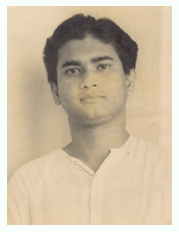
Suvo Guha Thakurta
Suvo Guha Thakurta, a young, ardent devotee of Rabindrasangeet, used to frequent soirees held at Santiniketan and at the Brahmo Samaj, from the age of eighteen. His close association with Indira Devi Choudhurani, Sailajaranjan Majumdar, Kanika Bandopadhyay, Arundhati Devi led to numerous lessons in Rabindrasangeet under the tutelage of the first two.
Sailajaranjan had once expressed to Suvo Tagore’s lament that his music was increasingly getting limited to Santiniketan and the Brahmo Samaj, and not reaching the wide audience it deserved to do. Sailajaranjan expressed a wish to Suvo that some measure be taken whereby Rabindrasangeet could be brought to the Bengali masses. It had been Tagore’s firm belief that a day would come when Bengalis would recognize and appreciate the centrality of his songs in their lives. Henceforth committed to the cause and determined to see results, Suvo, after a few years of struggle, founded Gitabitan on the 8th of December, 1941 at a rented house in Bhowanipore. In no time it was flourishing as a Rabindrasangeet institution. However, due to differences in opinion regarding its functioning, Suvo Guha Thakurta dissociated himself from it in 1947 and founded Dakshinee on the 8th of May, 1948, at 132, Rashbehari Avenue, Calcutta (now Kolkata), India.
Born to Nirmal Chandra Guha Thakurta and Kamala Guha Thakurta at their Ballygunge Place residence in 1937, Ritu Guha started singing at a very tender age. She started her training in Rabindra Sangeet at Gitabitan in 1941 but later shifted to Dakshinee in 1948 and ultimately graduated from there in the year 1956.
She has several music albums to her credit. Her first album was released in 1961 during Tagore’s Centeneray year celebrations. She has performed extensively in the country and abroad. Her speciality was to sing classical based – Rabindra Sangeet and she chose to perform and record the unusual and not so common songs by Tagore.
A revered singer, Ritu Guha has a mesmerizing voice and an unique style of rendition. She remains an inspiration to many singers of this genre of music.
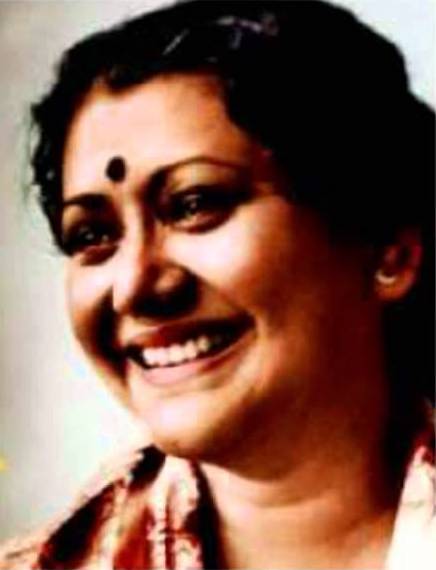
Ritu Guha
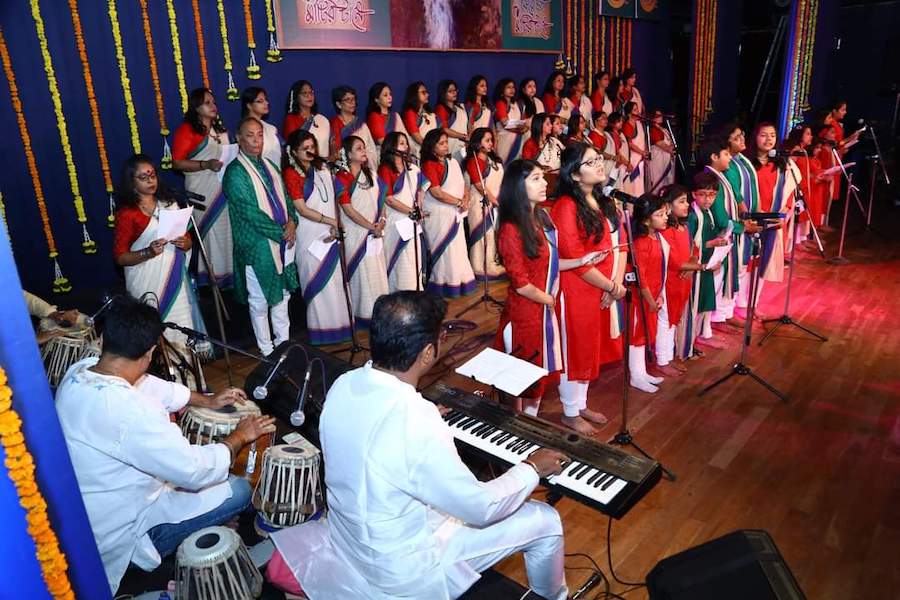
Rabindra Sangeet
Rabindra Sangeet are songs written and composed by Rabindranath Tagore.
The rendition has a very distinctive style where equal importance is given to both lyrics and music and inherently possess within them, a near perfect balance, an endearing economy of poetry and musicality.
In his songs, Tagore has written on a wide range of themes like humanism, introspection, romance, reflection, modernism. Tagore primarily worked with these subjects – first, the human being and second, Nature and then the relationship between the human being and Nature.
It is a distinctive genre of music which is based on Hindustani Classical music, Carnatic Ragaas, Western tunes and popular Folk Music. Lyrics and music both hold almost equal importance in 2,230 songs written by Tagore can be found in the collection known as the Gitabitan (garden of songs). The six major parts of this book are Puja (worship), Prem (love), Prakriti (seasons), Swadesh (patriotism), Aanushthanik (occasion-specific), Bichitro (miscellaneous) and Nrityo Natya (dance dramas and lyrical plays).
The Swarabitan, published in 64 volumes, includes the texts of the songs and their musical notation. Tagore created some six new taals (some inspired by Carnatic Talas) because he felt the traditional taals existing at the time could not do justice and were coming in the way of the seamless narrative of the lyrics. Rabindra Sangeet has had a very strong influence on Bengali culture.
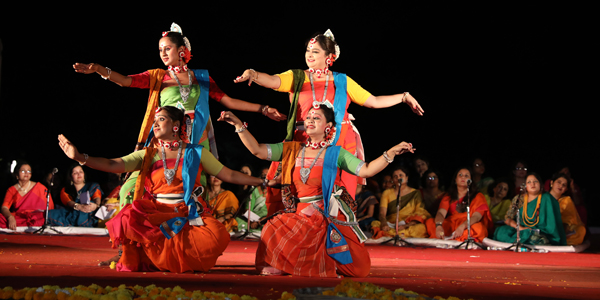
Rabindrik Nritya
Rabindrik Nritya is a distinctive style of dance, conceptualized and popularised by Rabindranath Tagore.
The style is an amalgamation of various styles like Indian classical, particularly Manipuri and Kathakali, folk dances, some South Asian styles like Candy from Bali.
The main focus is to express through movement and abhinaya, the lyrics and philosophy of the song penned by Tagore. The costumes are also very typical, characterised by the extensive use of batik sashes, silver and handmade jewellery and fresh flowers.
There is a fluidity and grace in the form and movement which makes it distinct from other dance styles. This style is believed to be best suited to accompany the songs of Tagore.
Course & Centres
As an affiliated unit of Dakshinee, Srijon follows the same syllabus, teaching process and examination pattern.
A Diploma is awarded on completion of the course.
Age 6 to 75 are open for admission. Classes are held both in-class and online.
The teaching faculty is also ably trained and guided to ensure valuable learning.
Andheri
Powai
Kandivali
Thane
Nerul
Our Faculty

Sutapa Bandopadhyay Sarkar
Sutapa’s journey with music started at the tender age of six under the guidance of her father Shri Jayanto Bandopadhyay and later she joined Dakshinee, Kolkata
Post her intense training in Rabindrasangeet and in recognition of her prowess as an artiste, Sutapa was entrusted the responsibility of leading the Rabindra Sangeet Faculty by Shri Sudeb Guha Thakurta when Srijon was founded in 2010 .
Sutapa has the rare talent of being an extremely good performer as well as an impeccable trainer and mentor.

Raju Saha
At the tender age of 3 years, Raju started taking Tabla lessons first from Sri Pradeep Chatterjee and then from the renouned maestro Sri Gyan Prakash Ghosh.
Raju has been a part of Srijon from the Foundation day of the Institute. He is a member of the Faculty, taking classes as well as being an accompanying musician during performances.
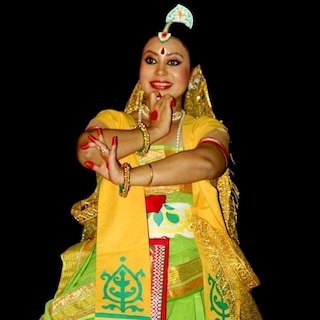
Sukanya Sengupta
A classically trained dancer, Sukanya has over 20 years of experience in choreographing and performing various dance styles namely Bharatnatyam and Odissi.
Her primary inclination is towards Rabindrik Nritya – a distinct style of dance, in which different dance styles are incorporated to express the lyrics of Tagore’s songs.
Along with the same, she has been regularly involved in scriptwriting, translating the literary works of Tagore on the prestigious stages and dance festivals of Mumbai. Since 2015, Sukanya is involved in teaching Rabindrik Nritya to members in Srijon.

Mitali Sen
Born in a Brahmo family, Mitali grew up in an environment imbued in Rabindranath Tagore’s philosophy, thinking, songs and poetry. Tagore’s influence on her life was further enforced when she enrolled at the Visvabharati University, Santiniketan to study English Honours.
After marriage in 1976, she moved to Mumbai but continued to pursue dancing, learning Odissi, taking part in several programmes presented by Bengali associations promoting Tagore Culture.
Associated with Srijon from 2012, Mitali has been doing dance choreography and conducting classes of Rabindrik Nritya and bringing her unique talent in costume designing.

Sreyashi Dasgupta
Tagore and music had always been a part of Sreyashi’s childhood and to nourish her passion for music, she started learning Rabindra Sangeet at ‘Dakshinee’, Kolkata.
After shifting to Mumbai, Sreyashi joined Srijon in 2016, first as a student and later became a part of the Faculty.
Her primary emphasis as a teacher at this institute, is to try to make the young generation imbibe the nectar of Tagore’s compositions in particular and music in general.

Ravikant Upadhyay
Known for his humility and dedication, Ravikant has been associated with Srijon Foundation since 2014.
From handling data to accounts, he looks after the operations and keeps our functioning smooth.
He believes that whichever work one chooses to do, one should put their heart and soul into it.